
AGI Introduction
Envision a world where careers are not limited to tasks whose processes have been pre-set into machines and where work is done in an incredibly smart way that fuses technology and somewhat humanistic features. A world where programmed machines can autonomously drive vehicles, conduct intricate specialized studies, service different customers with different needs and stroll into the uncharted territory wishing to take it all.
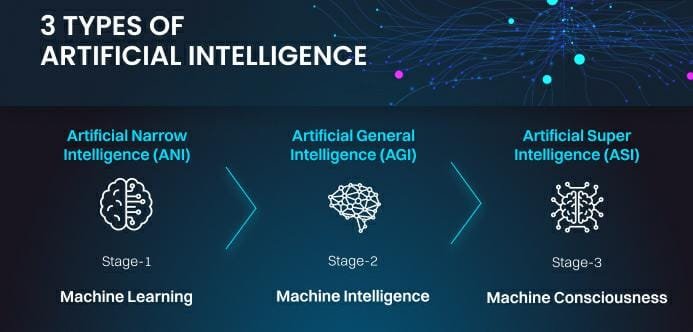
This is the power that General Artificial Intelligence (AGI) holds, which remains as pure speculation for the economy, but is then likely to bring about massive impactful change expected to touch every conceivable aspect of life and work on earth. Regardless of the fact is theoretical, organizations may seek to get ahead of it by taking the necessary preparation in building a solid data infrastructure and encouraging an environment of cooperation among humans and AI in the same workplace.
AGI (Scaffolded Projected Advanced Intelligence):
sometimes tagged as strong AI is the science fiction of artificial intelligence. The realization of AGI transcends artificial machine intelligence domains into human-like learning, perception and flexibility. However, also lacks biological necessities and thus does not get tired. They work in a virtual coliseum where they continue learning and processing out of the normal. The possibility of crafting so-called artificial minds that can learn from their surroundings and can carry out complex tasks is set to change the way many industries operate as machine intelligence takes over jobs that require human intelligence and brain power.
Today’s generative artificial intelligence, or gen AI, is frequently referred to as narrow AI and is particularly proficient at scanning through huge quantities of data, putting automation into processes, and writing text equivalent to human effort. Nevertheless, understanding is not inherent in these systems and hence they behave in their trained manner only. This gap illustrates the difference that exists today and expected in future AI which is AGI.
What posture should organizations take when the subject of AGI surfaces?
Given its high-end nature, AGI is difficult to design a precise tech stack for organizations. Bulks of ordinary techniques are available through the usage of narrow AI if AGI is the incremental development based on narrow AI.
How the general intelligence would be incorporated in the final AGI is still an open question in the field. Some, for example Goertzel and Pennachin (link resides outside of ibm.com), believed that AGI should be able to understand themselves and have self-control. Programmers working for Microsoft and OpenAI (link resides outside of ibm.com) do not believe such a thing, claiming that GPT-4 is nearly indistinguishable from a human being in almost all of its tasks. However, most scholars regard it as a very interesting, but still narrow AI system.
What are the types of AGI?
The advent of AGI represents revolutionary technology that would change the dynamics of how healthcare or manufacturing businesses will be done. The large tech corporations and the laboratories are investing all possible means for its development, with schools of thought trying to address the issue of machine intelligence at the same level as humans. A few key areas of interest are:
1.Symbolic AI: this paradigm deals with constructing systems which express knowledge through symbols and formal logic. The goal is to build a system that is able to comprehend and resolve issues applying rules much the same way people employ logic.
2. Connectionist AI (artificial neural networks): This strategy derives from the organization of human brain neurons. It includes designing a synthetic nerve network with many connecting hubs capable of learning computing incorporating numerous information.
3. Artificial consciousness: this area attempts to give machines emotional contents self- consciousness. This is still the realm theory but could provide one of the most important aspects of total intelligence.
4. Whole brain emulation: In this approach, which is considered to be rather ambitious, e.g., one attempts to build a thorough computer model which simulates a biological brain. The theory is based on the idea that by the virtual replication of the structure and the functions of the human brain, consciousness and intelligence could arise.
5. Embodied AI and embodied cognition: This particular approach seeks to analyze the intelligence of an agent based on the agent’s body and the happenings within the environment. The idea is that this agent has to do things in the world, rather than just being a brain, in order for learning to occur.
The AGI research field is constantly evolving. These are just some of the strategies which have been safe in the historical timeline. A combination of these techniques or new ones will probably help bring to reality AGI.
Improving AI to reach AGI
AI has come a long way in recent years, but creating machines with human-level smarts, or AGI still faces big challenges. Here are 7 key abilities that today’s AI finds tough and AGI would need to get right:
1. Seeing things: Computer vision has gotten better at spotting faces and objects, but it’s nowhere near as good as humans. Current AI has trouble with context, colors, and figuring out what to do when things are hidden.
2. Hearing things: AI has improved at recognizing speech but still can’t get accents, sarcasm, or other emotional tones in speaking. It also struggles to tune out unimportant background noise and has a hard time understanding non-verbal sounds, like sighs, laughs, or changes in how loud someone speaks.
3. Fine motor skills: AGI software might team up with robotics hardware. If this happens, the AGI would need to handle delicate objects, use tools in real-world settings, and adapt to new physical tasks.
4. Problem-solving: Weak AI shines at solving specific clear-cut problems, but AGI would need to solve problems like a human using reasoning and critical thinking. The AGI would have to deal with uncertainty and make choices with incomplete info.
5. Navigation: Self-driving cars show off impressive skills, but human-like navigation calls for quick adaptation to complex surroundings. People can find their way through busy streets, rough terrain, and changing environments.
6. Creativity: AI can come up with creative text to some extent, but real creativity involves coming up with new and original things. Humans stand out in their ability to create fresh ideas, concepts, and solutions.
7. Social and emotional connection: Human smarts are tied to our social and emotional skills. For AGI to match this, it would need to spot and grasp emotions, including reading faces, body signals, and how people speak. To react well to emotions, AGI must change how it talks and acts based on how others feel.
Conclusion:
To wrap up, Artificial General Intelligence (AGI) has a major impact on the field of artificial intelligence by mimicking the flexible problem-solving abilities of the human brain. While AGI remains a vision for the future, our current achievements like personal assistants, self-driving cars, and healthcare virtual assistants give us a glimpse of what’s to come. On the other hand, developing AGI requires us to overcome challenges in cognitive architecture, learning algorithms, and ethical considerations. As we work towards this groundbreaking technology, we’ll see different fields come together and create strong ethical guidelines. This approach will help minimize potential drawbacks while allowing AGI to benefit society.
Want to explore what comes after AGI? Every machine needs to level up. It’s called “ASI – Artificial Super Intelligence.”
Do follow links for more Contents : https://athenas.co.in/unveiling-the-secrets-behind-network-device-enhance/https://www.techtarget.com/searchenterpriseai/definition/artificial-general-intelligence-AGI








One Response